|
Extreme 2
Empress Real-Time Features:
Empress Real-Time Data Collector (RTDC)
Introduction
Real-time
applications must be deterministic. These applications control highly
sophisticated systems, such as robotic manipulators on factory floors, ground
satellite stations or next generation IP-based routers. Most systems require a
constant ingest of data in order to obtain sufficient information. Modern
real-time applications depend on vast amount of data, hence they require some
kind of a database management system (DBMS) component. However, since a
database grows incessantly it lacks predictability - an important criteria for
a real time application.
Furthermore,
many real-time applications depend to a large degree on constant feedback
collected by monitoring stations or sensors. Such data must be ingested in real time and often needs to be
permanently stored for later analysis (e.g. temperature, humidity, air
pressure, etc.)
The
challenge therefore is to transform a variable database management system into
a precise and deterministic tool to satisfy the uncompromising requirements of
real time sensory data collection.
One of such tools is Empress Real-Time Data Collector (Empress RTDC).
Overview
of the Empress RTDC
Empress RTDC
is a collection of APIs, utilities, clients and servers for facilitating
real-time data collection into an Empress database in a client-server
environment
RTDC is
expected to run primarily in an environment where real-time data is first
collected on a set of client machines, then sent to a server machine, and then
stored in an Empress database. The
client machines are expected to be less powerful machines running real-time or
stripped-down operating
systems possibly without consoles, file systems and hard drives. The server
machine is expected to be a normal disk-based system running Unix-like or
Microsoft Windows 2K/XP-like operating systems.
The flow of the real-time data in the Empress RTDC is shown in the
Figure 1.
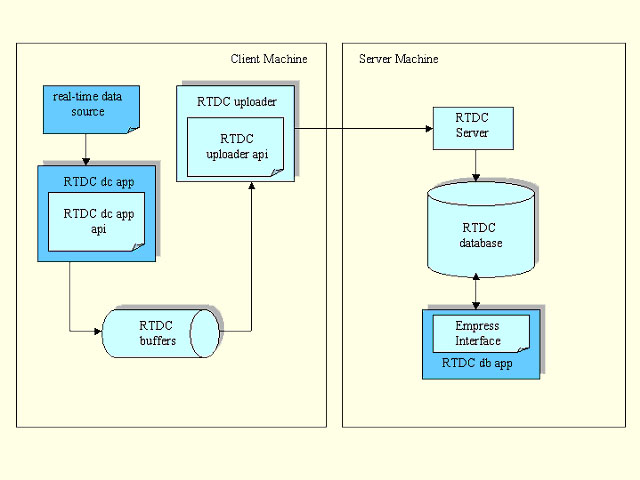
RTDC consists of the following components.
- On the
client machines:
- RTDC data
collection applications (RTDC dc app) - these are developed by the RTDC
application developer to collect the real-time data typically from operating
system functions and to pass the data to RTDC buffers through the RTDC
dc app api;
- RTDC
dc app api- a set of
library functions to be called from the RTDC dc apps to pass the
real-time data to the RTDC buffers; the real-time data may be augmented
automatically with such data as timestamps;
- RTDC
buffers- sets of
memory buffers to hold the real-time data from the RTDC dc app api to be
retrieved through the RTDC uploader api; each RTDC dc app on a
client machine uses different sets of buffers; each set of buffers act in a
circular fashion;
- RTDC
uploader api- a set of
library functions to be called by the RTDC uploader to retrieve the
real-time data from the RTDC buffers;
- RTDC
uploader- an
Empress client that runs in the background that retrieves the real-time data
through the RTDC uploader api and sends the data to the RTDC server.
- On the
server machine:
- RTDC
server- a server
that receives the real-time data from the RTDC uploaders on the client
machines and stores the data in the RTDC database;
- RTDC
database- an
Empress database to store the real-time data; each set of RTDC buffers
on a client machine corresponds to a single table; the table may be shared by
the same set of RTDC buffers on different client machines;
- RTDC
database applications (RTDC db app) - these are developed by the RTDC
developer to operate on the data in the RTDC database.
- On the
development (server) machine:
- RTDC
configuration info generator - a utility that assists the developer in generating
human-readable configuration info from the schema of the RTDC database;
the configuration info is required by many of the RTDC components;
- RTDC
dc app maker- a utility
that (cross) compiles and links an RTDC dc app with the appropriate
libraries to form an executable or thread-object for the client machine; it may
also convert configuration info files to static data and bind this data to the
dc app;
- RTDC
uploader maker- a utility
that links the RTDC uploader with the appropriate libraries to form an
executable or thread-object for the client machine; it may also convert
configuration info files to static data and bind this data to the RTDC
uploader.
On the Client Machine
The RTDC
dc app and the RTDC dc app api together form a real-time task. The
task can be a process or a thread depending on the developer's inclination and
the support of the operating system. The task must run fast enough to collect
one set of real-time data and pass the data on to the RTDC
buffers before the next set of data is ready. Empress has no control over
the RTDC dc app portion of the task as it is developed by the real-time
application developer. The RTDC dc app api portion of the task must be
developed to run as fast as possible and be as small as possible.
The RTDC
uploader and the RTDC uploader api together form another task. The
task can be a process or a thread depending on the support of the operating
system. The task should run fast enough to retrieve the real-time data from the
RTDC buffers and send the data to the RTDC server so that no data
is lost. The task is designed to run as fast as possible and be relatively
small. However, since the task usually runs in the background with lower
priority, and its speed is subject to the vagaries of client-server
communications as well as the responsiveness of the
RTDC server,
no guarantees can be made. Since the
architectures of the client machine and the server machine can be expected to
be different, the RTDC client must address the issue of cross-platform data
exchange.
The RTDC
uploader task normally creates and initializes the RTDC buffers on
startup and removes them on exit. Invocation parameters can alter this
behavior.
The RTDC
buffers form an intermediary between the RTDC dc app tasks and the RTDC
uploader task. The buffers are implemented in shared memory or in thread
global data depending on the support of the operating system. Each RTDC dc
app task uses a different set of buffers. The RTDC uploader task
deals with all the sets of buffers. Each set of buffers act in a circular
fashion, so that if all the buffers are full of un-retrieved data, the buffer
with the earliest data is the one overwritten with new data. In this way, if
the RTDC dc app task passes data to the RTDC buffers faster than
the RTDC uploader task can retrieve the data, some data will be lost,
albeit the earlier data. The number of buffers in a given set reflects the
bridging of the behavior of the two tasks trading off the desire of zero data
loss versus the size of memory occupied by the buffers.
There is no
locking mechanism implemented on the RTDC buffers. This eliminates the potential problem of the
RTDC uploader task blocking the RTDC dc app task which must run
in real-time. Two RTDC dc app
tasks do not share the same set of RTDC buffers.
In addition
to actual real-time data, the RTDC buffers may optionally contain
timestamps and application IDs.
The client
machines are expected to be less powerful machines running real-time or
stripped down operating systems possibly without consoles, file systems and
hard drives. Some of these operating systems do not support processes and
shared memory, but only threads. Thus, they present several porting
considerations for Empress development. For the RTDC components that run on the
client machines, they must be able to run as processes or threads, so that
effectively they must be multi-threaded. They must highly restrict the
operating system functions that they depend on for maximum portability.
Without
consoles, file systems and hard drives, the RTDC components cannot depend on
console or file I/O functionality from the operating system. They cannot get
configuration info from files. The configuration info must be bound into the
object codes of the components themselves as static data. For the RTDC dc app api, any error detected can be
indicated to the RTDC dc app as an error code and subsequent handling of
the error will be the responsibility of the RTDC dc app.
On the Server Machine
The RTDC
server is a conventional Empress server. It receives real-time data from RTDC
uploaders tasks on various client machines and stores the data in an RTDC
database. Since the architecture of
the client machines and the server machine are expected to be different, the RTDC
server must address the issue of cross-platform data exchange. As the RTDC
server works on a conventional machine, it reads configuration info from
files.
The RTDC
database is a conventional Empress database. Each set of RTDC buffers on a client machine corresponds
to a single table; the table may be shared by the same set of RTDC buffers
on different client machines.
The RTDC db app is a conventional Empress application that may
use any of the Empress database interfaces.
On the Development (Server) Machine
The RTDC
configuration info generator is a utility that assists the RTDC developer
in generating human-readable configuration info from the schema of the RTDC
database. The configuration info is required by many of the RTDC
components. While the developer can create and hand-edit any configuration
information, a significant portion of the configuration info must correspond
exactly to the RTDC database. For example, the size and structure of an RTDC
buffer depends entirely on the schema of the corresponding RTDC database
table. Generating this type of configuration info with a utility can eliminate
many potential sources of error. This utility can also generate C header files
with data structure definitions for the convenience of the developer in
developing the RTDC dc apps.
The RTDC
dc app maker is a utility that (cross) compiles and links an RTDC dc app
with the appropriate libraries to form an executable or a thread-object for the
client machine. It is effectively a
wrapper around the appropriate (cross) compiler.
The RTDC
uploader maker is a utility that links the RTDC uploader with the
appropriate libraries to form an executable or thread-object for the client
machine. It is effectively a wrapper around the appropriate (cross) compiler.
An additional task of the RTDC dc app maker and the RTDC
uploader maker is to convert configuration info files to static data and
bind this data to the dc app and uploader. Different pieces of configuration info are
required by the different components of the dc app and uploader
tasks. For example, the RTDC buffers require their size and structure
and the RTDC uploader require client-server communications configuration
info. All of them require the standard Empress initialization info.
Various Scenarios/Configurations Using Empress RTDC
In the most common case there will be one RTDC data collection
application per client machine/device. However, Empress RTDC allows many different scenarios in using multiple
number of RTDC data collection applications, RTDC uploaders or RTDC
servers. Figure 2 shows only some of them.
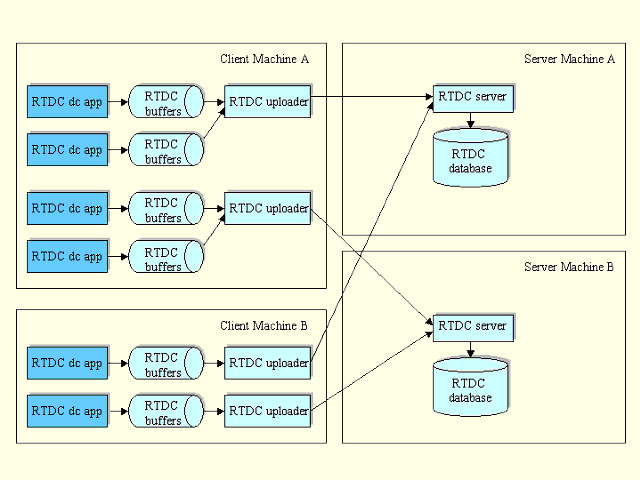
Figure 2. Different Scenarios using the Empress
RTDC
There could
be multiple RTDC data collection applications per one RTDC uploader.
There could
be multiple RTDC uploaders per one client machine.
One RTDC
uploader can upload data only to one RTDC server.
One RTDC
server can upload data from many RTDC uploaders.
Conclusion
Empress RTDC
is a small footprint data collection (data ingest) tool that is deployed on
real time devices.
With the
addition of the RTDC product to its portfolio, Empress Software Inc. becomes
the only commercial database vendor to offer deterministic database behavior in
its server and client offerings.
|